


Femtoscopy with Monte Carlo Simulations
Monte Carlo study of momentum correlations in high-energy collisions using Pythia, aimed at characterizing the size and shape of the fireball created in heavy-ion collisions
Femtoscopy in Proton–Proton Collisions at √s = 7 TeV
This project was carried out as my servicio social at the Instituto de Ciencias Nucleares (UNAM) and represents my first formal research experience in high-energy physics, prior to my bachelor’s thesis. The work focused on femtoscopy, a technique used to probe the space–time structure of particle-emitting sources in high-energy collisions.
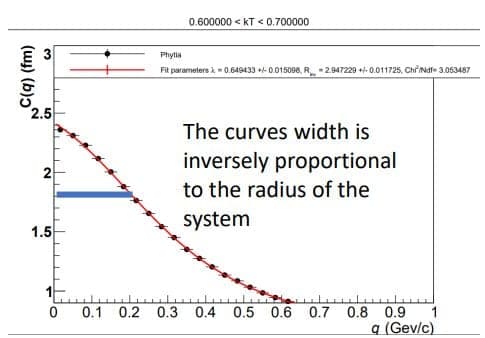
Femtoscopy exploits Hanbury Brown–Twiss (HBT) correlations between identical particles to extract characteristic length and time scales of the interaction region. In this study, the method was applied to simulated proton–proton collisions at √s = 7 TeV generated with Pythia 8, including Bose–Einstein correlations.
The analysis was based on constructing two-particle correlation functions using both same-event particle pairs and mixed-event pairs to model the uncorrelated background. By studying the relative momentum distributions and their dependence on transverse momentum (kT), it is possible to infer the effective size and geometry of the particle-emitting source.
Special attention was given to the physical interpretation of the correlation variables and to the implementation of event mixing, ensuring that the background preserved single-particle kinematics while removing genuine correlations. The study also explored how model parameters controlling the Bose–Einstein effect influence the extracted femtoscopic radii.
The results of this work were presented at the 4th Annual Meeting of the ALICE Network in Mexico, held in Puebla de los Ángeles, within the Detectors and Phenomenology session. This project laid the foundation for my later work in collider physics, data analysis, and detector-related studies.
Links
Tags
Skills