


Estimation of the number of multiparton interactions on pp collisions at ALICE using TMVA ROOT
Bachelor’s thesis project using ROOT TMVA to perform feature ranking, decorrelation, and comparison of multiple machine learning models for regression and classification tasks.
Machine learning classification and regression of multiparton interactions in pp collisions — Bachelor’s project
This bachelor’s project developed machine‑learning (ML) methods to estimate how many multiparton interactions (MPI) occurred in individual proton–proton (pp) collision events recorded by ALICE. The work was motivated by an observed excess of particle activity in the transverse region of pp events, a feature that prompted debate: some groups proposed tiny droplets of quark–gluon plasma, while our lab championed an explanation based on multiparton interactions combined with color reconnection during hadronization. The goal here was to move beyond qualitative arguments and build an event‑by‑event estimator of MPI using only detector‑level observables.
Context and motivation (non‑expert friendly)
In each collision the detector records many particles. MPI are multiple scatterings between constituent partons (quarks and gluons) inside the protons that can increase particle activity in an event. In simulated events you can set the number of MPI, but in real data MPI occur before the particles are formed and are not directly observable — they must be inferred from quantities the detector measures.
Two observables strongly correlated with MPI are:
- Multiplicity: how many particles the detector sees in the event.
- Spherocity: how uniformly particle momenta are distributed (0 = jet‑like, 1 = isotropic/spherical).
Project goals
- Select and preprocess detector‑level features informative about MPI.
- Rank and decorrelate features (ROOT/TMVA) to remove redundant information.
- Train and compare classifiers to separate high‑MPI from low‑MPI events.
- Find an optimal working point and compare ML selection with the traditional spherocity×multiplicity cut.
- Perform regression to predict the actual number of MPI per event (novel for this analysis).
Data and training strategy
Training and testing used dedicated Monte Carlo productions to mimic ALICE detector conditions. For the NMPI (number of MPI) work the classifiers were trained using the LHC18f1 sample anchored to LHC16k, and testing was performed on LHC15g3c3 — this separation helps evaluate model generalization to independent samples [machine_learningfin1.pdf].
Feature selection and preprocessing
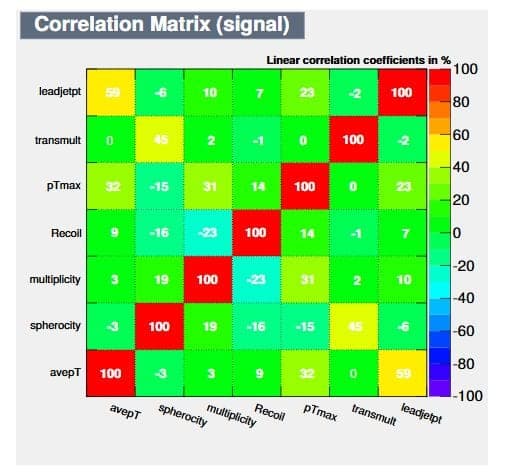
After reconstruction, a set of candidate observables was prepared (examples: multiplicity, spherocity, average pT, sphericity, recoil, leading pT). ROOT/TMVA ranking was used to determine which variables had the most discrimination power. A covariance / decorrelation step removed variables that were only useful because they were correlated with stronger variables; the result was a compact set of orthogonal, informative features that improved model stability and reduced overfitting.
Models trained and rationale
Multiple methods were compared, including boosted decision trees (BDT), multilayer perceptrons (MLP), and linear discriminants. Linear methods can fail when the separation boundary is nonlinear; tree‑based and neural methods (BDT, MLP) performed better for this problem. Models were trained on MC truth labels (high/low MPI for classification and numeric MPI for regression) and evaluated on independent test samples [machine_learningfin1.pdf].
Evaluation and results
Classifier performance was summarized with signal efficiency vs background rejection curves. ML‑based selections improved separation power compared with the simple spherocity×multiplicity cut, providing better control of purity and efficiency. Most notably, regression models produced continuous estimates of the number of MPI per event — a capability not previously available in this analysis chain and useful for quantitative model‑data comparisons.
Novelty and impact
The key novelty is event‑by‑event regression of MPI counts using detector observables. This enables direct, quantitative tests of competing explanations for the transverse‑region activity (e.g., MPI+color reconnection vs. QGP hypotheses) and can be used to correlate MPI estimates with other observables. The feature‑ranking and decorrelation workflow plus the TMVA training/evaluation process is also broadly applicable to other situations where a latent (unobserved) quantity must be inferred from measured data [machine_learningfin1.pdf].
Files and links
Tags
Skills