


Diphoton Discrimination with Graph Neural Networks
Exploration of graph neural network methods using reconstruction-level detector information to improve discrimination between diphoton signal and electron background, under constraints from simulation–data mismodeling.
Graph Neural Network Experimentation for Diphoton Event Selection
This project explores the use of Graph Neural Networks (GNNs) to improve diphoton event selection in ATLAS analyses, with a particular focus on low-mass H → γγ searches. The work was conducted alongside my Ph.D. research on diphoton background modeling and aims to overcome limitations of traditional multivariate methods.
In Run-2 analyses, diphoton event selection relied on a multi-stage Boosted Decision Tree (BDT) approach, operating on summary variables and fixed candidate ordering. While effective, this strategy is not well suited for handling variable-length detector information such as tracks and vertices, nor for exploring all possible photon-pair combinations in complex events.
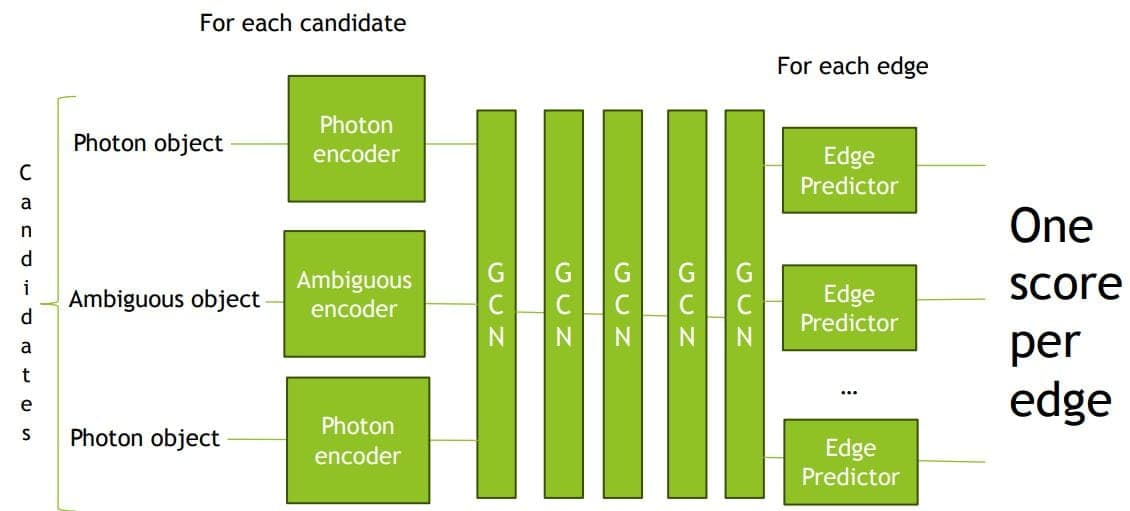
To address these challenges, I designed and evaluated a GNN-based architecture that represents each event as a fully connected graph, where nodes correspond to photon or ambiguous electron/photon candidates and edges represent possible diphoton pairings. The task is formulated as an edge prediction problem, allowing the model to directly identify the most likely diphoton pair within each event.
A key component of the approach is a flexible encoder design that maps heterogeneous reconstruction objects into a common latent representation. Scalar features are combined with variable-length information from tracks and conversion vertices using dedicated neural encoders, including GNN-based sub-encoders for structured inputs. This allows the model to retain detailed reconstruction information without premature pooling or hand-crafted summarization.
The resulting architecture naturally incorporates correlations between candidates, scales to events with many objects, and removes the need for heuristic preselection of photon pairs. The project demonstrates how modern graph-based methods can align more closely with the underlying structure of HEP reconstruction data while remaining compatible with ATLAS analysis workflows.
This work was presented multiple times within the ATLAS and HEP-ML communities, including international workshops and collaboration-wide meetings, reflecting growing interest in GNN-based approaches for event-level inference.
Links
Tags
Skills