


Diphoton Background Modeling (Z→ee)
Ph.D. research project focused on modeling the Z→ee background in diphoton analyses using optimal transport techniques to model fake photons invariant mass distributions.
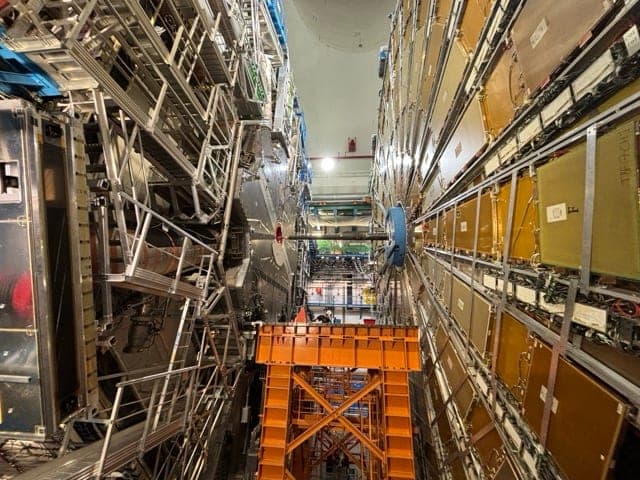
Diphoton Background Modeling
This project is part of my Ph.D. research within the ATLAS Collaboration and focuses on the modeling of backgrounds in diphoton final states, a key channel for precision measurements and searches for physics beyond the Standard Model, including Higgs-related analyses.
In diphoton analyses, the dominant backgrounds arise not only from genuine photon production but also from events in which electrons are misidentified as photons. These misidentifications originate from reconstruction ambiguities in the inner detector and electromagnetic calorimeter, such as missing or partially reconstructed tracks, photon conversions, and bremsstrahlung-induced energy loss.
My work addresses this challenge by developing a data-driven background modeling strategy that simultaneously estimates both the rate and the invariant-mass shape of misidentified events. Rather than attempting to correct individual objects, the method models the observed diphoton invariant mass as a probabilistic transformation of the true underlying distributions.
A central component of the approach is the use of probability density functions (PDFs) and their corresponding cumulative distribution functions (CDFs) to map correctly reconstructed events to the mass distributions expected from one or two particle misidentifications. This framework allows the construction of consistent mass templates without relying on direct truth-level information.
The model further incorporates event-level misidentification probabilities, accounting for correlations between leading and subleading particles and extending naturally to multiple analysis categories, including multivariate (BDT-based) selections. Normalization constraints are treated carefully to remain robust against residual correlations and reconstruction effects.
This work provides a scalable and statistically well-defined method for diphoton background estimation, improving sensitivity in precision measurements and new-physics searches while remaining compatible with the reconstruction realities of the ATLAS detector. Detailed results and validations are currently under internal review and are therefore not yet public.
Tags
Skills